

About yodeling
Yodeling is

Liberating
The yodeller ...
… does not conform to any rules. It is the expression and very embodiment of freedom and an irrepressible zest for life! It is wordless, formless, unforced and authentic. A genuine, natural yodel comes from the heart and touches the heart. It is like a musical dialogue or the telling of a story. Very often, it is associated with strong emotions. In the broad, calm yodels, one finds the primal human need to make sound and to resonate with other voices. Unsurprisingly, yodeling brings people and groups together in a spirit of deep connection within a very short space of time.

Moving
At the heart of ...
… is the traditional yodel. These ancient, wordless themes of folk music captivate listeners with their power and their simple beauty. This is not about the virtuoso yodeling seen on folk variety shows or produced for the media, but about the traditionally handed-down yodel in its natural polyphonic form. yodeling awakens an archetypal longing for constancy, clarity and tranquillity in an age characterised by a constant increase in pace. It also stirs a need for nature and for one’s own natural self.
Connecting
yodeling takes place ...
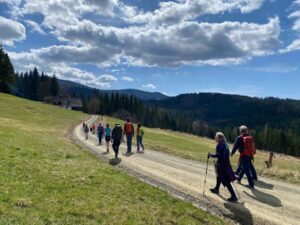
… not alone, but in pairs, threes or fours, on the mountain, at the regulars„ table, and preferably out in the great outdoors. It’s all about listening and attuning to one another. Allowing yourself to “switch registers’ from chest voice to head voice requires a little confidence in your own voice to begin with. Start singing with gusto, pluck up a bit of courage, and it’ll soon become easy: that liberating feeling comes from the rapid shift between resonance chambers and the relaxed movement of the larynx. yodeling is simply fun – yes, sometimes even a bit mad!
Juchezer
What is yodeling?
yodeling is the archaic singing the Alps. The Singing and shouting was once used for communication and later found its way into folk music. The focus is on the signalling function used to convey messages. To do this, one uses the Strength the voice and what it can do naturally! The body serves as an instrument.
yodeling is one of the most remarkable and diverse genres of Alpine folk music. With various local variations, yodeling is an ethnic form of singing and expression found particularly in mountainous regions. yodeling was once used for communication and only later found its way into folk music. Thus, yodeling in the Alpine region an integral part of traditional folk culture, although songs that change key is not limited to Austria, Bavaria and Switzerland.
Frequent changes in voice pitch (register changes) and the onomatopoeic use of syllables are archaic features of human musical activity, as found amongst peoples worldwide can be found and form an integral part of cultural practices there. Forms of throat singing and register shifting can thus be found on every continent. To describe these chants globally as „yodeling“ would probably be too narrow a definition, if we consider, for example, „joik“ in Scandinavia or the „yellis“ in Central Africa. An important distinction also lies in their purpose, which ranges from social and communicative to spiritual and ritual.
Characteristic Characteristics of yodeling These include frequent shifts between chest voice and head voice (or falsetto) (register changes), tightly controlled polyphony, wide interval leaps and the almost exclusive use of major keys. Another distinctive feature of yodeling is singing or calling out on vowel syllables. Vowels serve as the vehicle for the sound and make the vocalisation seem effortless. Syllables and melody are very closely intertwined.
The Yodel syllables are unconsciously selected according to phonetic principles: the closed vowels i, u, ü support the head voice, whilst the open vowels a, å, o, e support the chest voice, although u and e are borderline cases and are used in both registers. The human vocal apparatus determines which vowels are suitable for carrying messages over long distances: for example, the „i“ carries over long distances and reaches its destination far away. Consonants play a secondary role. They link the vowels together or indicate ornamentation. The frequent alternation between vowels has a further effect: it creates a wealth of overtones, which determine the timbre.
To the The origins of yodeling There may be various theories. What is undisputed is that it has its roots in communication over long distances. yodeling and the ‘Juchezer’ were originally used as a means of communication in alpine and mountain farming. They developed from signals between people (as a means of communication from one alpine pasture to another, or, for example, to coordinate work parties during timber harvesting in the forest), or from people to animals (calls to lure livestock). Another hypothesis suggests that yodeling originated from dance music. Research is also being carried out into the idea that yodeling may involve an imitation of the alphorn. Hans Gielge, for his part, vividly describes the highs and lows of yodeling by tracing the contours of the alpine and mountain landscapes.
A „Juchezer“ is a very simple, spontaneous expression of joy, whilst a „Almschrei“ refers to a unanimous call, which is partly melodic in nature and may contain words. „Yodeller“ are sung in parts as „Miteinand“, „Gegeneinand“ or „Füreinand“ and „Hintereinand“, usually in two or three parts, and occasionally in four parts.